On this page
- 981 vs 718 at a glance
- Years and models
- Engines: naturally aspirated six vs turbo four
- Steering: both electric, the 718 is quicker
- Chassis, weight and size
- Interior
- Manual vs PDK
- Known issues on each
- What to check on a 718 (and a 981)
- What 981s and 718s cost now
- Which should you buy?
- Frequently asked questions
- Sources
The 718 Boxster and Cayman replaced the 981 for 2017 with one big change in the regular models: the naturally aspirated flat-sixes gave way to turbocharged flat-fours. Officially the new cars were more powerful, made far more torque and were quicker to 60 mph, on the same 97.4-inch wheelbase. Later 718s even brought the six back, in the GTS 4.0, GT4 and Spyder. Porsche ended 718 production in October 2025. Here's what actually changed, what the official sheets say, and which one we would shop with a stick.
01981 vs 718 at a glance
| 981Boxster MY2013-16, Cayman MY2014-16 | 718Boxster and Cayman from MY2017; production ended Oct 2025 | |
|---|---|---|
| Regular-model engines | Naturally aspirated 9A1 flat-six, 2.7 and 3.4, both DFI | Turbocharged flat-four, 2.0 (base) and 2.5 (S and early GTS), both DFI |
| Base power (US) | Boxster 265 hp / 206.5 lb-ft; Cayman 275 hp / 213 lb-ft | Boxster 300 hp / 280 lb-ft. Cayman US sheet lists the same unladen weights and power-to-weight ratios as the Boxster |
| S power (US) | Boxster S 315 hp / 266 lb-ft; Cayman S 325 hp / 272 lb-ft | Boxster S 350 hp / 309 lb-ft, same weight and power-to-weight pattern on the Cayman S sheet |
| Later six-cylinder models | Cayman GT4 385 hp; Boxster Spyder 375 hp; GTS 330/340 hp (Boxster/Cayman) | GTS 4.0 394 hp / 309 lb-ft; Cayman GT4 and 718 Spyder 414 hp / 309 lb-ft (2020 US sheet) |
| 0-60 mph, base Boxster | 5.5 s manual; 5.4 s PDK; 5.2 s PDK with Sport Chrono | 4.9 s manual; 4.7 s PDK; 4.5 s PDK with Sport+ |
| IMS bearing | None | None |
| Steering | Electromechanical, variable ratio (16.5:1 to 12.37:1 on the 2014 Cayman sheet) | Electromechanical, variable ratio (15.0:1 to 12.5:1). Porsche said this is 10 percent more direct on center, using the 911 Turbo steering gear |
| Wheelbase | 97.4 in. (2,475 mm) | 97.4 in. (2,475 mm) |
| Boxster weight, manual / PDK | Curb 2,888 / 2,954 lbs (2013 US sheet) | Unladen 2,944 / 3,010 lbs (2017 US sheet) |
| Manual / automatic | Six-speed manual standard; optional seven-speed PDK. GT4 and Spyder were manual only | Six-speed manual standard on the regular range; optional seven-speed PDK. From the 2021 model year, PDK was also optional on GT4, Spyder and GTS 4.0 |
The comparison most buyers are really making is a 981 S or GTS against a 718 S or later GTS 4.0: same mid-engine layout and the same wheelbase, with a different engine note and a lot more midrange torque in the turbo cars. If you are still weighing a 987, start with our 981 vs 987 guide.
02Years and models
- 981 Boxster: MY2013-2016 (Boxster, Boxster S, GTS from 2015, Spyder for 2016).
- 981 Cayman: MY2014-2016 (Cayman, Cayman S, then GTS and GT4 for 2016 in the US). A 2013 Cayman is still a 987.2.
- 718 Boxster and 718 Cayman: launched as 2017 models. Porsche's internal type number is 982. Regular models used turbo flat-fours; the name 718 is a nod to Porsche's four-cylinder mid-engine race cars of the 1950s and 1960s.
- 718 GTS (2.5 turbo): 365 hp from the 2.5, before the GTS switched to a 4.0 flat-six.
- 718 GTS 4.0, Cayman GT4 and 718 Spyder: naturally aspirated 4.0 flat-sixes. US GTS 4.0 cars were offered for 2021 with 394 hp. The 2020 US GT4 and Spyder sheet lists 414 hp.
- End of production: Porsche reported in October 2026 that production of the 718 model line ended in October 2025. Residual deliveries continued after that.
That makes the 981 the last generation whose regular Boxster and Cayman models used a naturally aspirated flat-six. The six came back later in the 718 range, but only in the GTS 4.0, GT4, Spyder and related RS models, not in the base or S cars.
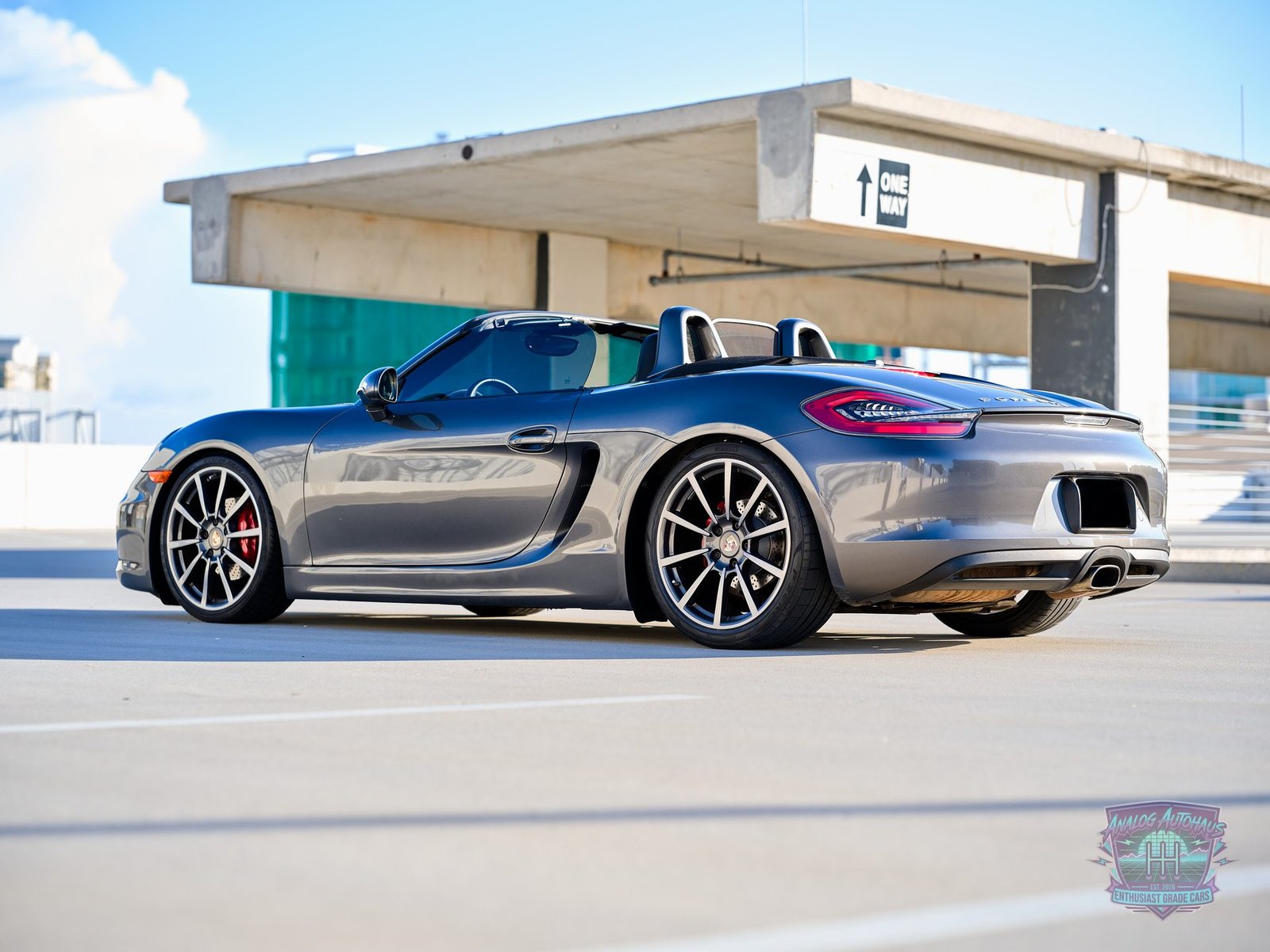
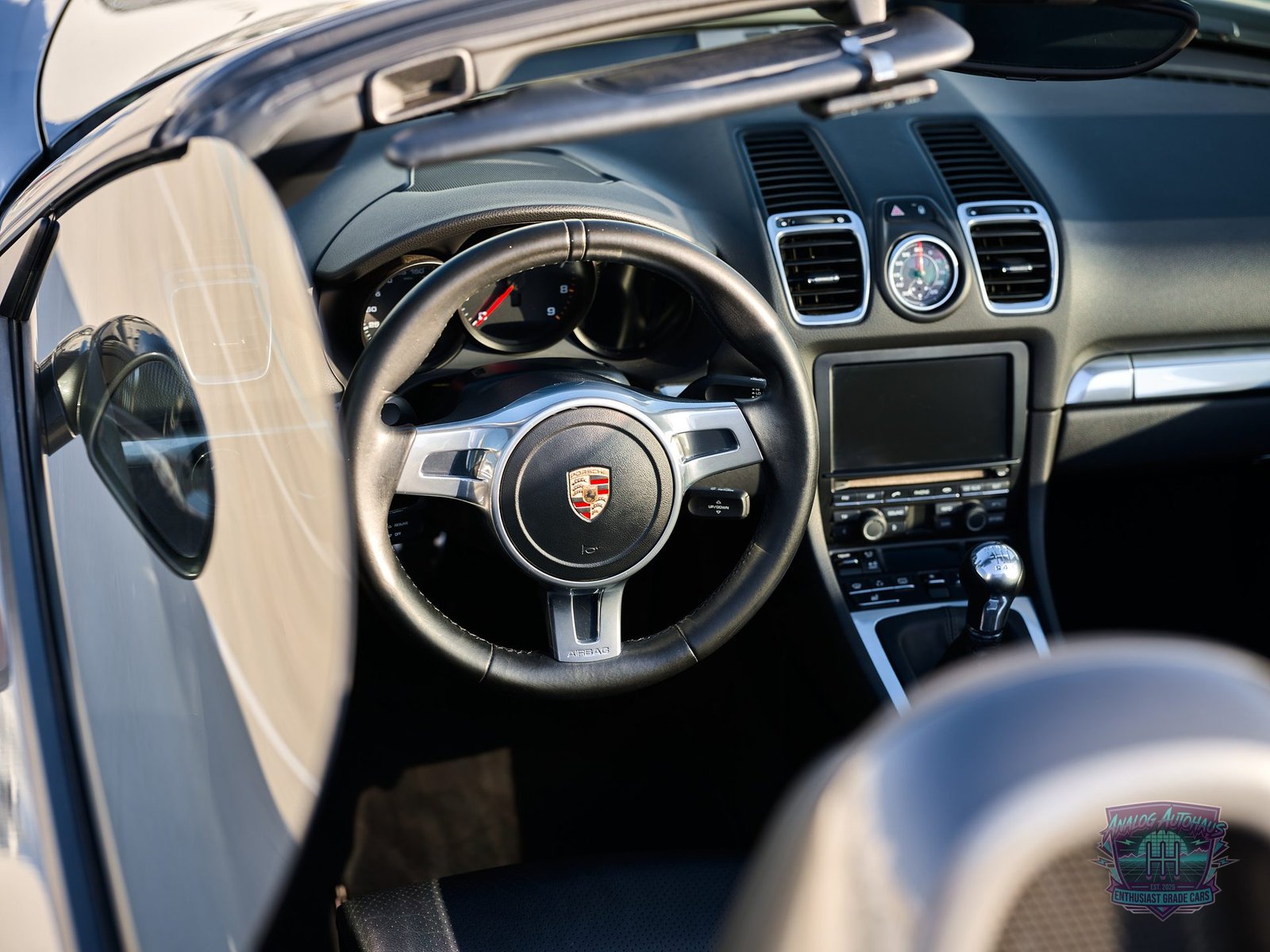
03Engines: naturally aspirated six vs turbo four
This is the whole argument, and the official numbers are clear even if the sound is a matter of taste.
- 981 base 2.7 flat-six: naturally aspirated, direct injection (DFI), VarioCam Plus. Boxster 265 hp at 6,700 rpm and 206.5 lb-ft; Cayman 275 hp at 7,400 rpm and 213 lb-ft.
- 981 S 3.4 flat-six: Boxster S 315 hp and 266 lb-ft; Cayman S 325 hp and 272 lb-ft.
- 718 base 2.0 turbo flat-four: 1,988 cm³, 300 hp at 6,500 rpm and 280 lb-ft from 1,950 to 4,500 rpm. Porsche's US launch release puts that torque gain at 74 lb-ft, or 36 percent, versus the outgoing Boxster.
- 718 S 2.5 turbo flat-four: 2,497 cm³, 350 hp and 309 lb-ft from 1,900 to 4,500 rpm, with a variable-turbine-geometry (VTG) turbocharger. Porsche said that was a 35 hp and 43 lb-ft gain over the outgoing Boxster S.
- 718 GTS 2.5: the same 2.5 turbo family, rated 365 hp. The official Boxster GTS sheet lists 309 lb-ft for the manual and 317 lb-ft for PDK.
- 718 GTS 4.0: 3,995 cm³ naturally aspirated flat-six, 394 hp and 309 lb-ft, 7,800 rpm redline, six-speed manual standard. Porsche quoted 0-60 mph in 4.3 seconds and a 182 mph top track speed.
- 718 Cayman GT4 and 718 Spyder (2020 US sheet): the same 4.0 family at 414 hp and 309 lb-ft, with a six-speed manual on that sheet.
Porsche also quoted 0-60 mph in 4.5 seconds for a 718 Boxster with PDK and Sport Chrono, 0.7 seconds quicker than the previous Boxster with the same options, and 4.0 seconds for the 718 Boxster S with those options. The 2013 981 Boxster sheet lists 5.2 and 4.5 seconds for those Sport Chrono PDK figures.
Both generations use direct injection and have no intermediate shaft, so IMS is not a factor on either car. The four is quicker in a straight line and makes its torque much lower in the rev range. The six revs differently and sounds like a Porsche flat-six. That tradeoff is why a lot of buyers still shop 981 and 718 cars side by side.
04Steering: both electric, the 718 is quicker
Unlike a 987 vs 981 comparison, this is not hydraulic versus electric. Both generations use electromechanical power steering with a variable ratio.
On the 2014 Cayman sheet the 981 ratio is 16.5:1 on center to 12.37:1. On the 2017 718 Boxster sheet it is 15.0:1 on center to 12.5:1. Porsche's US launch release says the 718 system is ten percent more direct on center than the previous model and uses the steering gear from the 911 Turbo. Power Steering Plus, which lightens the steering at low speed, was optional.
If hydraulic steering is the deciding factor, you want a 987, not a 981 or a 718. See our 981 vs 987 guide and the 987.1 vs 987.2 guide.
05Chassis, weight and size
The 718 sits on the same 97.4 in. (2,475 mm) wheelbase as the 981. Porsche did not stretch the car. It did reskin almost all of it: the US launch release says every body part was changed except the front and rear luggage compartment lids, the windshield and the roadster top.
- 981 Boxster (2013 US sheet): overall length 172.2 in., curb weight 2,888 lbs with the manual and 2,954 lbs with PDK.
- 718 Boxster (2017 US sheet): overall length 172.4 in., unladen weight 2,944 lbs with the manual and 3,010 lbs with PDK.
- Luggage: both list 5.3 cu. ft. in front. The 981 Boxster lists 4.6 cu. ft. in the rear; the 718 Boxster lists 4.4 cu. ft.
The official sheets use "curb weight" for the 981 and "unladen weight" for the 718, so treat the 50-odd-pound gap as a listed comparison, not a lab weigh-in. In use, both are mid-engine, rear-drive cars with MacPherson-type suspension at both ends and optional PASM and PTV.
On fuel, the 2013 981 Boxster sheet lists combined EPA figures of 24 mpg (manual) and 26 mpg (PDK). The 2017 718 Boxster sheet lists 24 mpg (manual) and 29 mpg (PDK). The turbo four's official economy gain shows up mainly with PDK.
06Interior
Porsche redesigned the 718 dash and made a then-current PCM touchscreen, SiriusXM, HD Radio and a universal audio interface standard on the 2017 cars, with navigation optional. Bi-Xenon headlights and Park Assist front and rear with a reversing camera were also standard at launch. The steering wheel design came from the 918 Spyder family, and the optional Sport Chrono package added a mode switch on the wheel.
For the 2021 model year in the US, Porsche made two-zone climate control, heated seats, auto-dimming mirrors with a rain sensor, Apple CarPlay, and PDLS Bi-Xenon headlights standard on the regular 718 range, including T, S and GTS 4.0.
The 981 cabin already felt like a jump from the 987. The 718 is the more modern place to spend a long drive, especially on later cars with CarPlay standard. Neither interior will feel like a 992, and both cars still have the mid-engine storage layout (a trunk at each end) rather than a 911's rear seats.
07Manual vs PDK
Both generations offer a six-speed manual as standard on the regular models, with a seven-speed PDK as the optional automatic. There is no seven-speed manual in either Boxster or Cayman; that gearbox belonged to the 911.
On the 981, the Cayman GT4 and Boxster Spyder were manual only. On the 718, the early GT4 and Spyder were also launched with a six-speed manual. For 2021, Porsche made the seven-speed PDK optional on the 718 Cayman GT4, 718 Spyder and 718 GTS 4.0 as well. The regular 718 range still came standard with the six-speed that year.
If a stick is the point of the car, both generations still give you one on the models most people actually shop. Confirm the gearbox on the specific car, especially on later GTS 4.0, GT4 and Spyder examples.
08Known issues on each
Neither car has the IMS bearing of the earlier M96/M97 engines. The serious, documented items to check are official recalls and service history, not a single inherited engine-out failure mode.
- 981, NHTSA 21V-679 (Porsche AMB7): Porsche recalled certain 2013-2015 Boxster, 2013-2014 Boxster S, 2014-2015 Cayman and Cayman S, and 2015 Boxster GTS and Cayman GTS cars because the rear-axle carrier side sections may fracture. A fracture can cause a loss of control. Dealers replace the side sections. About 4,934 vehicles were involved. Check that a given VIN has the remedy on file.
- 981 engines: these are 9A1 direct-injected flat-sixes. LN Engineering notes that 9A1 engines score at significantly lower rates than the older M96/M97 engines, not that scoring is impossible. Direct injection can also leave carbon on the intake valves over time. Specialist 981 guides also flag ignition coils, the high-pressure fuel pump, the water pump and the thermostat as wear and service items.
- 718, NHTSA 17V-054 (Porsche AH01): Porsche recalled certain 2017 718 Boxster, 718 Boxster S, 718 Cayman and 718 Cayman S cars (along with some 2017 911s) because the fastening screws for the fuel collection pipes can shear from stress corrosion cracking and allow a fuel leak in the engine compartment, with a fire risk. The US population in the filing was 4,090 vehicles. 718 production dates in that filing are early-build 2016 cars, not the entire 718 run. Dealers install improved screws. Confirm the remedy by VIN.
- 718 turbo fours: these are a different engine family from the IMS-era flat-sixes, and this guide does not treat bore scoring as a documented systemic 718-four issue. Independent specialist guides discuss wastegate rattle, ignition coils, water pumps, thermostats and oil use on some early turbo cars. A PPI and a VIN recall check remain the right next step.
09What to check on a 718 (and a 981)
- Run the VIN through NHTSA and a Porsche dealer for open campaigns, especially 17V-054 on early 718s and 21V-679 on earlier 981s.
- Get a pre-purchase inspection from a shop that sees these cars. A DME / over-rev report is worth doing on a Porsche you are serious about; we offer that service on our DME report page.
- On any 718 turbo car, listen for boost or wastegate noises, look at the cooling system and service records, and confirm the car has been driven hard enough, often enough, to stay clean inside the turbo and exhaust. Short-trip cars need a closer look.
- On a 981, confirm the axle-carrier recall where it applies, and inspect for the usual water-cooled 9A1 service items (coils, pumps, leaks, and a clean bill of health on a compression or leak-down test if the budget allows).
- On either generation, a documented clutch and flywheel (manual) or PDK service history matters more than a slightly higher option count.
- If you want the 4.0 six, do not assume a "718 GTS" is the 4.0. Early 718 GTS cars are still 2.5 turbo fours. The later cars are badged GTS 4.0.
10What 981s and 718s cost now
Used prices move quickly, so this guide does not quote a market average. For dated sale-price benchmarks, see our 981 vs 987 guide, and ask us for current comps on any car you are considering.
In qualitative terms only: a later 718 usually costs more than the equivalent 981, and the GTS 4.0, GT4 and Spyder sit in a higher band than the turbo-four cars. Clean, documented manuals often trade above average examples in the same year and mileage band.
New-car context, not current used values: the 2017 718 Boxster launched from $56,000 and the 718 Boxster S from $68,400, excluding destination. For 2021, Porsche listed the 718 Cayman from $59,900, the 718 Boxster from $62,000, the Cayman GTS 4.0 from $86,800 and the Boxster GTS 4.0 from $88,900, each plus a $1,350 delivery fee.
11Which should you buy?
- The naturally aspirated six in a regular-model car: a 981 S or 981 GTS manual. This is the last everyday Boxster or Cayman with a flat-six in the base/S/GTS range.
- More midrange torque and a newer car: a 718 S manual, or a later well-optioned base 718 if the 2.0's official 280 lb-ft is the point. Officially quicker, with a more modern cabin on later cars.
- The six back in a 718: a 718 GTS 4.0 if you want the 394 hp road car, or a Cayman GT4 / 718 Spyder if you want the 414 hp US cars and the more focused chassis. Budget accordingly, and confirm whether the car is a 2.5 GTS or a GTS 4.0.
- Hydraulic steering, or a lower buy-in: look at a 987.2 instead. That is a different comparison; use the 981 vs 987 and 987.1 vs 987.2 guides.
Whichever you choose, get a proper pre-purchase inspection first.
12Frequently asked questions
Is the 718 faster than the 981?
Does the 718 have a flat-six?
Do the 981 or 718 have the IMS bearing problem?
Is the 718 steering hydraulic or electric?
What years are the 981 and the 718?
Does every 718 GTS have the 4.0 six?
Looking for a manual 981 or 718?
We buy and sell manual Porsches in Sarasota and inspect them in-house. If you want help finding a 981 or a 718, tell us what you're after. Comparing the earlier cars? Read our 981 vs 987 guide or the 987.1 vs 987.2 guide.
Where these facts come from
- Porsche Cars North America, 2013 Boxster and Boxster S technical specifications: 265/315 hp, torque, curb weights, 0-60, EPA mpg, 97.4 in. wheelbase. newsroom.porsche.com
- Porsche Cars North America, 2014 Cayman and Cayman S technical specifications: 275/325 hp, 213/272 lb-ft, steering ratio 16.5:1 to 12.37:1, wheelbase. newsroom.porsche.com
- Porsche Cars North America, 2015 Boxster GTS and Cayman GTS technical specifications: 330 hp and 340 hp. newsroom.porsche.com
- Porsche Newsroom, "This is the new Porsche Cayman GT4" (2015): 3.8 L, 385 hp, six-speed manual only. newsroom.porsche.com
- Porsche, Boxster Spyder (981) US press information, June 2015: 3.8 L, 375 hp, six-speed manual only. newsroom.porsche.com
- Porsche Cars North America, 2017 718 Boxster and 718 Boxster S technical specifications: 300/350 hp, 280/309 lb-ft, unladen weights, 0-60, EPA mpg, steering ratio, wheelbase, six-speed manual and optional PDK. newsroom.porsche.com
- Porsche Cars North America, 2016 718 Cayman and 718 Cayman S technical specifications: same unladen weights (2,944/3,010 and 2,988/3,054 lbs) and power-to-weight ratios (9.8/10.0 and 8.5/8.7 lb/hp) as the 718 Boxster sheet, plus matching 0-60 and EPA figures. The engine-output page was not present in the PDF retrieved from Newsroom. newsroom.porsche.com
- Porsche Cars North America, "The new 2017 Porsche 718 Boxster" US launch release: 35 hp gain, 74 and 43 lb-ft torque gains, 0-60 in 4.5/4.0 s with PDK and Sport Chrono, 10 percent more direct steering and 911 Turbo steering gear, body panels changed except lids, windshield and top, launch MSRPs. newsroom.porsche.com
- Porsche AG press information, 20 years after the first Boxster, on the new 718 Boxster: 220 kW (300 hp) and 257 kW (350 hp), VTG on the S, up to 13 percent better fuel economy on the cycle used in that document. newsroom.porsche.com
- Porsche Cars North America, 718 Boxster GTS technical specifications: 365 hp, 309 lb-ft (manual) and 317 lb-ft (PDK). newsroom.porsche.com
- Porsche Newsroom USA, "The 2021 Porsche 718 Boxster and Cayman models" (June 24, 2020): GTS 4.0 394 hp and 309 lb-ft, 0-60 in 4.3 s, 182 mph, six-speed standard, PDK optional on GT4, Spyder and GTS 4.0; 2021 US starting prices. newsroom.porsche.com
- Porsche Cars North America, 718 Boxster GTS 4.0 and 718 Cayman GTS 4.0 US technical specifications: 394 hp, 309 lb-ft, 3,995 cm³, unladen 3,157 / 3,166 lbs, 0-60 in 4.3 s, 97.4 in. wheelbase, electromechanical steering. newsroom.porsche.com
- Porsche Cars North America, 2020 718 Cayman GT4 and 718 Spyder technical specifications: 414 hp and 309 lb-ft, six-speed manual on that sheet. newsroom.porsche.com
- Porsche Newsroom, "Porsche delivers 178,532 cars worldwide in the first nine months of 2026" (9 October 2026): "Production of the 718 model line ended in October of last year." newsroom.porsche.com
- NHTSA campaign 17V-054 (Porsche AH01), January 25, 2017: fuel collection pipe fastening screws may shear; 4,090 vehicles, including certain 2017 718 Boxster, Boxster S, Cayman and Cayman S. nhtsa.gov
- NHTSA campaign 21V-679 (Porsche AMB7): rear-axle carrier side sections may fracture on certain 2013-2015 981 Boxster/Cayman models; 4,934 vehicles. nhtsa.gov
- LN Engineering, "What Is Porsche Cylinder Bore Scoring": 9A1 engines score at significantly lower rates than earlier M96/M97 engines. lnengineering.com
- NHTSA service information for 17V-054 refers to the cars as 718 Boxster (982) / 718 Boxster S (982), which is the internal type number. nhtsa.gov