
On this page
- The 996 at a glance
- Which 996 is which
- 3.4 vs 3.6
- The IMS bearing, by year
- Rear main seal (RMS) leaks
- Bore scoring, cracked cylinders, slipped sleeves and cracked heads
- Cooling system, coolant tank and air-oil separator
- Manual vs Tiptronic
- Age-related items on every 996
- What a good 996 pre-purchase inspection includes
- What 996s are worth right now
- Which 996 should you buy?
- Frequently asked questions
- Sources
The 996 was the first water-cooled 911, and it's still the cheapest way into a 911 with a manual gearbox. It's also the 911 with the most internet horror stories. Most of them trace back to one engine family, the M96, and to a handful of problems you can check for before you buy. This guide covers which 996 is which, what actually fails, what a good inspection looks like, and what they're worth right now.
The short version: the Turbo and GT3 use a different engine and skip most of this. On a Carrera, the car's history matters more than its year. Buy the car with the paperwork, the clean borescope and the clean PIWIS scan with its over-rev ranges, not the one with the lowest price.
01The 996 at a glance
| 996.1US model years 1999–2001 | 996.2US model years 2002–2005 | |
|---|---|---|
| Engine | 3.4 L M96.01/.02/.04 flat-six, port injection, VarioCam | 3.6 L M96.03, VarioCam Plus |
| Output (US, SAE) | 296 hp (300 PS) @ 6,800 rpm, 258 lb-ft | 315 hp (320 PS) @ 6,800 rpm, 273 lb-ft |
| Models | Carrera coupe and cabriolet; Carrera 4 from MY1999; Turbo from MY2001 | Adds Targa and Carrera 4S (wide body). C2 ends after MY2004; C4S and Turbo run through MY2005 |
| Look | Shared Boxster-style "fried egg" headlights | Turbo-style headlights, new front bumper, oval tailpipes |
| IMS bearing (Carrera) | Dual-row on early engines, changing to the weaker single-row during 2000–01 | Single-row (the one to address). Replacement engines built 2006 or later have the larger, non-serviceable bearing |
| Cylinder risks | D-chunk cracked cylinders most common on 1999–2001 3.4s; slipped sleeves on some pre-2000 blocks; bore scoring possible | Bore scoring more common on the 3.6 |
| Transmissions | 6-speed manual or 5-speed Tiptronic S | 6-speed manual or 5-speed Tiptronic S |
| Cabriolet rear window | Plastic | Glass, heated |
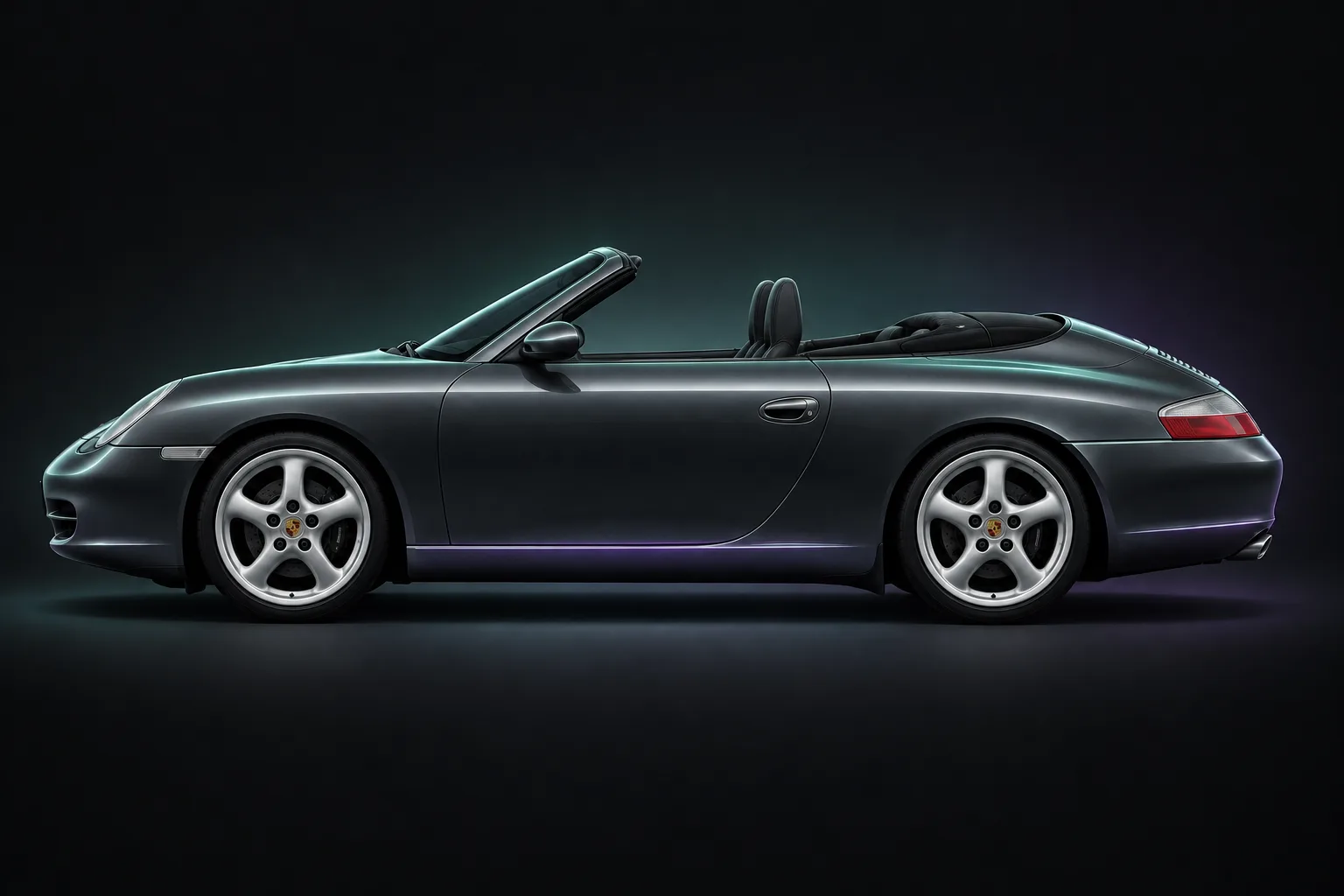
996.2 Carrera cabriolet, top down. From the 996.2, cabriolets got a heated glass rear window in place of plastic.
02Which 996 is which
- Carrera (coupe and cabriolet), MY1999–2004. The rear-drive base car. Hagerty puts a 1999–2000 coupe at about 2,900 lb. 1999 cars are prized by "analog" buyers for their cable throttle and cable-released trunk and engine lids, and early 1999s have amber indicators. Most cabriolets came with an aluminum hardtop.
- Carrera 4, MY1999–2004. Permanent all-wheel drive, same body as the Carrera. It adds about 200 lb, per Hagerty. The 2000 Millennium Edition C4 coupe was limited to 911 cars in Violet Chroma Flair, according to Porsche.
- Targa, MY2002–2005. Not a lift-off roof: a large sliding glass roof plus a rear window that opens like a hatch. 3.6 engine.
- Carrera 4S, MY2002–2005 (cabriolet MY2004 in the US). The naturally aspirated 3.6 in the Turbo's wider body, with the Turbo's brakes and suspension layout. No more power than a Carrera, but it's the 996 most buyers want today.
- 40th Anniversary 911 (MY2004). 1,963 cars in GT Silver, with the X51 power kit (345 hp, 345 PS per Porsche), a limited-slip differential and sport suspension.
- Turbo, GT2 and GT3. These use the race-derived Mezger engine, with plain bearings on the intermediate shaft, so the IMS and bore-scoring problems below don't apply. The Turbo (415 hp, 420 PS; 450 hp with X50 or in the Turbo S) arrived for MY2001, and the GT3 reached the US for MY2004. Their known weak spot is the factory-bonded coolant pipes, which can let go under hard use. The fix is to pin or weld them. Expect bigger maintenance bills, since many jobs mean dropping the engine.
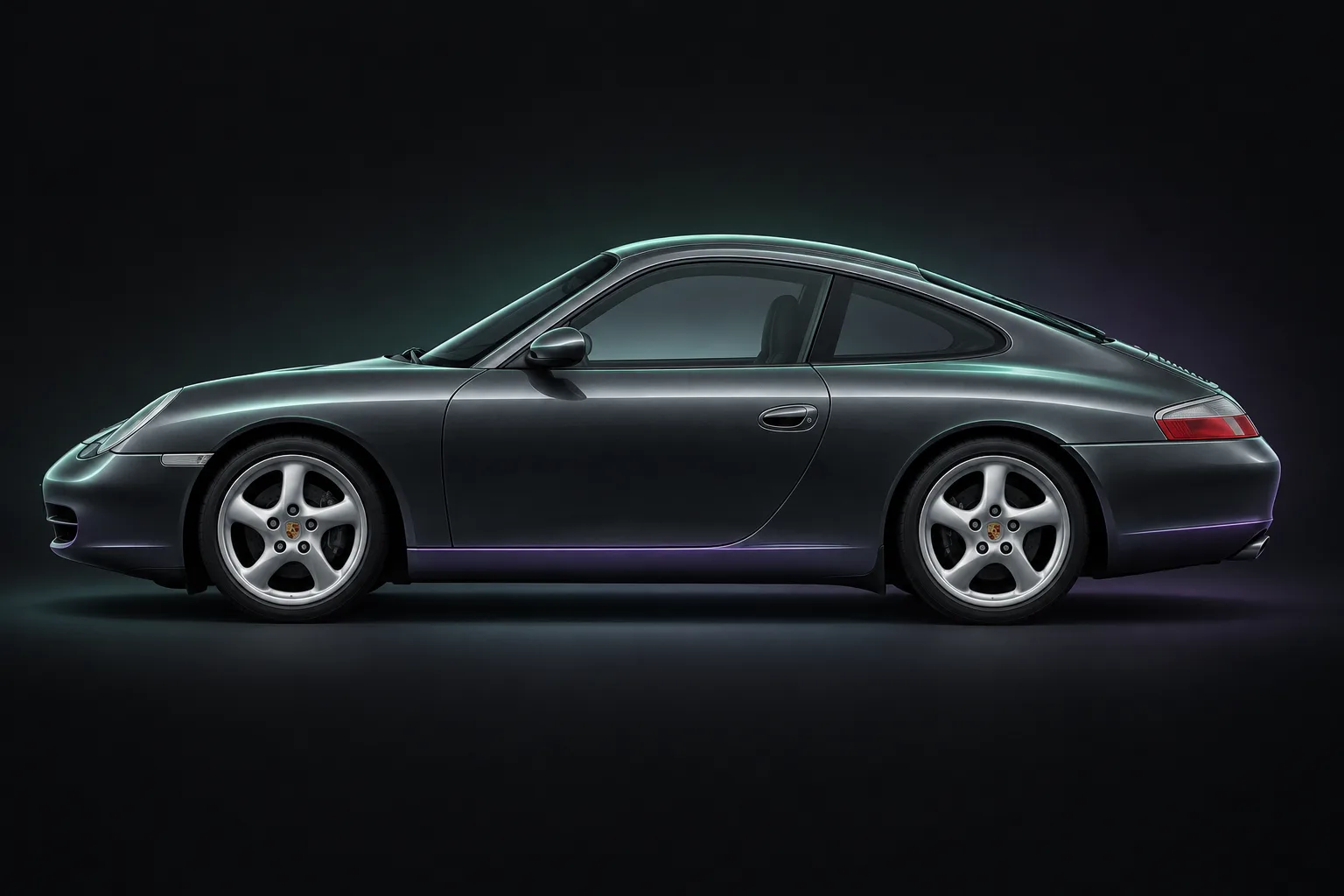
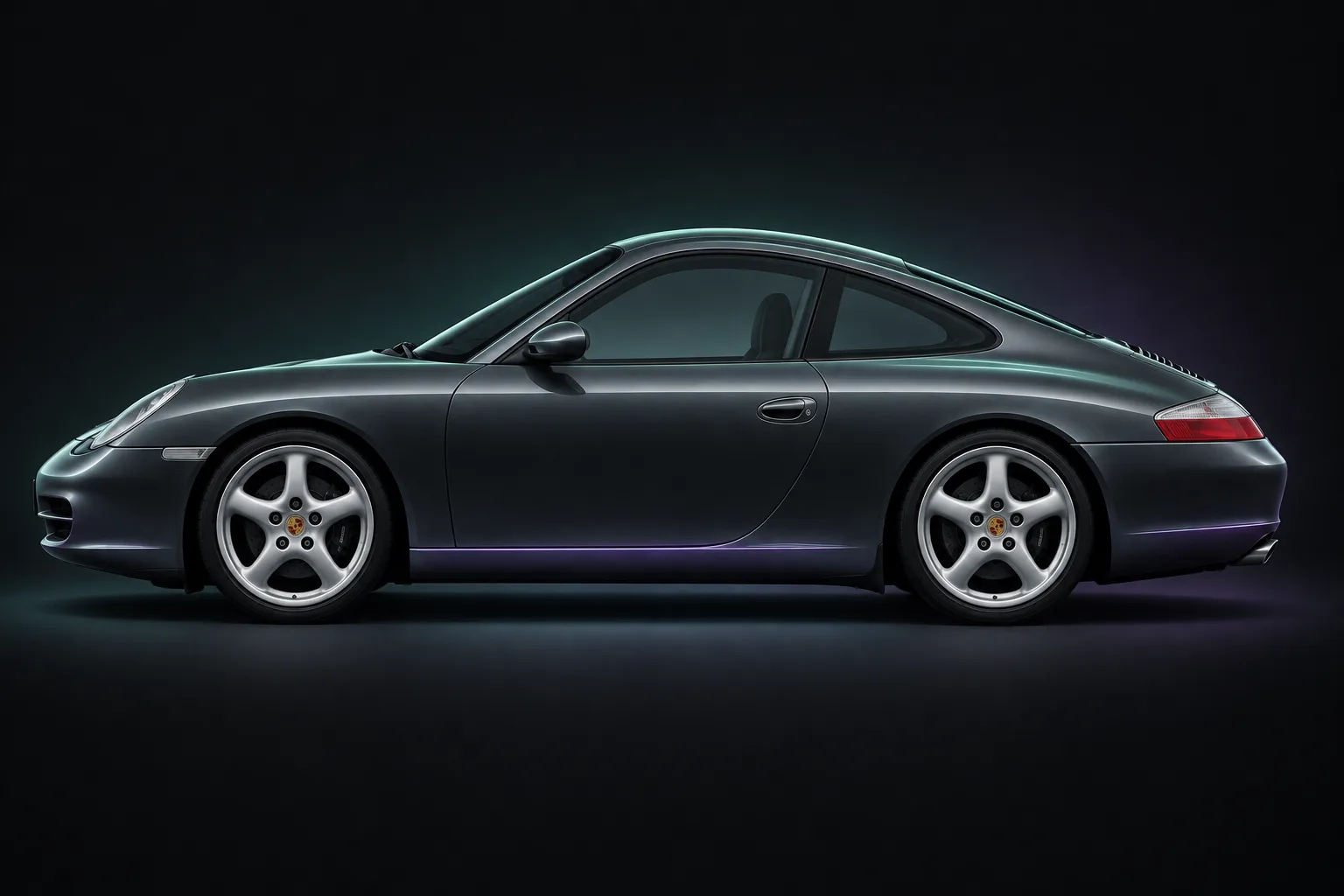
996.1 (left) and 996.2 (right) Carrera coupes. In profile they're nearly identical; the giveaway is up front: the 996.1's "fried egg" headlights vs the 996.2's Turbo-style lights and new bumper.
033.4 vs 3.6
For 2002, Porsche lengthened the stroke from 78.0 to 82.8 mm, taking the engine from 3.4 to 3.6 liters. It added VarioCam Plus (cam phasing plus two-stage intake valve lift), which gave 315 hp (320 PS) and 273 lb-ft in US trim.
The 3.6 is the stronger engine on paper, and the more bore-scoring-prone one in practice. LN Engineering says the 3.6 and 3.8 are affected more often than the 3.4. It points to the longer stroke: the 3.6's pistons drop about 7 mm out of the bore at the bottom of the stroke, against about 2 mm on the 3.4, which adds side loading. Hagerty agrees that scoring is more common on the 3.6.
The 3.4 has its own list: cracked cylinders ("D-chunk," most common on 1999–2001 3.4s per LN), slipped cylinder sleeves on some early blocks, and cracked cylinder heads. LN lists spark-plug-well cracks as "common" on the 996 3.4 head. More detail below.
Neither is the "safe" one. The way to pick between them is the inspection, not the displacement.
04The IMS bearing, by year
The intermediate shaft (IMS) drives the camshafts. On the M96, one end rides on a sealed ball bearing that Porsche never gave a service interval. If it fails, cam timing can be lost and metal debris goes through the engine. Hagerty says that typically means a $20,000–$30,000 rebuild.
What a 996 Carrera has depends on when its engine was built:
- Early 996 engines (1999, and some 2000–01): a dual-row bearing. About 1% failure rate in the Eisen class-action data, per LN. Hagerty stresses that these still "can and do fail."
- Phased in during 2000–01, and every engine from 2002 to 2005: a smaller single-row bearing with about half the load capacity. About 8% in the same data. This is the one to deal with. LN also warns that it can go from no visible debris to failure without warning.
- The larger single-row bearing (2006–08) went into 997.1 and 987.1 engines, not 996s. A 996 can still have one if its engine was replaced with a factory unit built in 2006 or later, and LN says some late-2005 engines got it too. That bearing can't be replaced without fully disassembling the engine.
- Turbo, GT2 and GT3: no IMS ball bearing at all.
Model year alone won't tell you which bearing a car has. Many 996s are on factory replacement engines. LN notes that engines replaced on early cars (often for slipped sleeves or rear main seal leaks) can be identified by an AT, X or Y in the engine serial number. Check the engine number and the paperwork.
The fixes. On a serviceable 1999–2005 engine, the bearing can be replaced with the engine in the car. The options are a ceramic-hybrid IMS Retrofit or a roller kit (both wear items; LN's current kits have a 6-year/75,000-mile interval) or LN's IMS Solution, a pressure-fed plain bearing with no replacement interval. Porsche released its own ceramic-hybrid kit in 2017. LN estimates 10–14 hours of labor, plus about $1,000 for a Retrofit kit or about $2,000 for the Solution. Tiptronic 911s need the engine and transmission lowered, so the job costs more. It's a preventive job only: if the bearing is already shedding metal, a new bearing won't save the engine.
A documented retrofit has a serial number you can check in LN's online IMS Lookup. "IMS seal replaced" on an invoice isn't the same thing as a bearing replacement.
05Rear main seal (RMS) leaks
The RMS seals the back of the crankshaft, right above the IMS flange. On the 986 and 996, it's the classic oil leak. UK specialist Revolution Porsche calls it the most common leak on non-Turbo 986/996s. A seep isn't an emergency, but you only get to it with the transmission and clutch out, so it's expensive labor.
What matters when you're buying:
- Not every leak there is the RMS. A leaking IMS flange can look the same, and LN notes a worn IMS bearing can make that flange leak. Excellence's tech column (via Callas Rennsport) says the tell is oil on the case between the RMS and the IMS flange. If it's lower, at the flange, suspect the IMS.
- The fix is the latest genuine PTFE seal (Porsche 0PB 105 249), installed dry with the correct tool at the right depth. LN says chronic leakers usually come from engines machined out of tolerance at the factory. Porsche's 9699/1 gauge checks runout between the crank and the seal bore, and LN's limit is 0.3 mm.
- Do it with the clutch and IMS. The labor overlaps almost completely, so a car that's due for a clutch is the time to do the RMS, the IMS bearing and the IMS flange seal together.
06Bore scoring, cracked cylinders, slipped sleeves and cracked heads
Bore scoring. The M96 uses Lokasil aluminum-silicon cylinders with no iron liner. When the piston-skirt coating and the oil film break down, the piston scuffs the bore. The result is oil consumption, a tick often mistaken for a lifter, and eventually a rebuild. LN lists every 1999–2005 996 Carrera engine, 3.4 and 3.6, as able to score, with the 3.6 the more common. Warning signs from LN and Hagerty: one tailpipe sootier than the other, a tick at idle, rising oil use. Only a borescope confirms it.
Cracked cylinders ("D-chunk"). A crack through the cylinder wall into the water jacket causes oil-coolant intermix. LN says it's most common on 1999–2001 3.4 996 engines, and Hagerty also describes the D-shaped crack. Either failure is terminal for the original block.
Slipped sleeves and porous blocks. LN reports that some early Boxster and 996 blocks were sleeved at the factory with thin metal-matrix sleeves. Those sleeves can work loose and drop, usually at low mileage. LN believes this is limited to 986 and 996 engines made before model year 2000. Early crankcases could also be porous, weeping oil through the casting itself.
Cracked cylinder heads. LN says the most common M96 head failure is a crack from overheating, usually after a water pump failure: broken plastic impeller pieces block coolant passages in the head. It also lists spark-plug-well cracks as common on the 996 3.4 head. LN's prevention advice is to replace the water pump before it fails and fit a 160°F low-temperature thermostat.
What it costs if you're wrong: LN's fixes for scored, cracked or slipped cylinders mean a full rebuild with new sleeves (its Nickies). That's the $20,000–$30,000 territory Hagerty quotes.
07Cooling system, coolant tank and air-oil separator
- Coolant expansion tank. Pelican Parts calls it "one of the top ten jobs" on an older Carrera. The plastic tank cracks at its seam with age. Look for a yellowed tank, coolant residue on the bulkhead, or coolant under the rear trunk carpet. A cold pressure test at about 13–15 psi finds slow leaks.
- Water pump and thermostat. See above. The water pump is cheap insurance against a cracked head. If the records don't show one recently, budget for it.
- Air-oil separator (AOS). It manages crankcase vacuum. When it fails, oil gets pulled into the intake. On a 996, LN notes the cold-start smoke cloud that Boxsters show may be less obvious, so don't diagnose by smoke alone. LN's manometer numbers for the M96: normal is about 4–6 in. of water of vacuum, and 10–15 in. or more means a failed AOS. A failed AOS can also cause lean codes, a "honking" noise and a hard-to-remove oil cap.
08Manual vs Tiptronic
The 996 came with a six-speed manual or a five-speed Tiptronic S torque-converter automatic. The takeaway for buyers:
- The market pays for the manual. Hagerty knocks about 15% off for a Tiptronic. In the CLASSIC.COM market averages below, manuals run about $8,000–$11,000 higher on coupes and about $3,000–$4,000 higher on Carrera cabriolets and the Targa.
- The Tiptronic makes the IMS job costlier. LN notes the engine and transmission have to be lowered on Tiptronic 911s.
- Manual gearboxes are generally strong. Hagerty says older units can show worn synchros or a whining differential or pinion bearing. Check for both on the test drive.
- The manual is also where over-rev history matters most. A missed downshift can show up in the DME's over-rev ranges (see the PPI section).
10What a good 996 pre-purchase inspection includes
- Engine history first. Engine serial number (look for AT, X or Y replacement-engine prefixes), IMS status with a retrofit serial number you can check in LN's IMS Lookup, and invoices for the RMS, clutch, water pump, AOS and coolant tank.
- Scan with PIWIS or equivalent: stored faults, plus the DME over-rev ranges. Not every DME records them, so on those cars a blank over-rev page isn't proof of a clean history. Where the DME records them, the report sorts over-revs into Ranges 1–6. Per a PCA tech advisor, Range 1 is usually just the rev limiter, Ranges 4–6 point to a mechanical over-rev that can cause internal damage, and Porsche won't certify a car with Range 4 or higher as pre-owned. (The rpm limits for each range vary by engine, so read them off the report itself.) Compare the last event's engine hours with current hours, and ask whether the DME was ever replaced, since a new unit starts with a clean history.
- Borescope all six cylinders for scoring, and look for any sign of cracking or a sleeve that has moved.
- Oil filter inspection. Ferrous "silver glitter" that sticks to a magnet points to the IMS bearing. Non-magnetic aluminum points to bore scoring.
- Crankcase vacuum test for the AOS, with a manometer.
- Cooling system pressure test, plus checks for oil-coolant intermix in the oil and the coolant tank.
- Cam deviation and fuel trims (both on LN's IMS pre-qualification list), and a leak check at the RMS and IMS flange with the engine-bay and underbody covers off.
- Chassis and test drive: control arms and bushings, synchros, diff whine, clutch engagement, top operation on cabriolets and the Targa roof.
11What 996s are worth right now
Two sources, measured differently, so treat them as a guide rather than a price tag for any one car:
- Hagerty (June 2026 buyer's guide, Rob Sass): manual Carrera coupes in #3 (good) condition "usually in the mid- to high-$20K range." Tiptronic cabriolets with around 100,000 miles can still be found under $20,000. A decent Turbo starts around $40,000 (Tiptronic cabriolet), with most manual Turbo coupes from about $60,000 to the high $80,000s. A good GT3 driver starts around $120,000. Hagerty's price guide (Feb 2025) values a 1999–2004 Carrera 4 Cabriolet at $19,500 in #3 (good) to $30,000 in #2 (excellent) condition, and takes 15% off for Tiptronic.
- CLASSIC.COM Market Benchmark (October 2026): a market average across every condition it tracks, including driven, high-mile and project cars.
| Market average, all conditions | Manual | Tiptronic |
|---|---|---|
| 996.1 Carrera coupe (1999–2001) | $30,235 | $22,104 |
| 996.1 Carrera cabriolet | $26,042 | $22,728 |
| 996.1 Carrera 4 coupe | $30,489 | $22,223 |
| 996.2 Carrera coupe (2002–04) | $33,014 | $21,966 |
| 996.2 Carrera cabriolet | $28,133 | $24,239 |
| 996.2 Targa | $31,271 | $27,798 |
| 996.2 Carrera 4S coupe | $43,097 | $32,031 |
| 996.2 Carrera 4S cabriolet | $38,799 | $29,922 |
| 40th Anniversary (2004) | $43,887–$46,149* | n/a |
| Turbo coupe (2001–05) | $79,845* | $51,593 |
*Clean examples trade well above these averages. Recent 40th Anniversary auction sales ran from $28,750 to $70,000, with a 12-month median of $47,000, and the cars with 13,000–30,000 miles brought $60,500–$70,000 (BaT, Nov 2025–Oct 2026). Low-mile manual Turbo coupes (7,000–39,000 miles) sold for $108,000–$147,000 on BaT from August to October 2026.
Because these benchmarks average in tired and project cars, clean, documented, low-mile manuals often trade above them.
Both sources agree on the pattern: coupes beat cabriolets, and the wide-body C4S carries a clear premium. In the CLASSIC.COM averages, manuals beat Tiptronics by about $8,000–$11,000 on coupes and about $3,000–$4,000 on Carrera cabriolets and the Targa. (The C4S cabriolet gap is closer to $9,000, and the Turbo's is much wider.) Hagerty adds that any car without documented preventive IMS work "should come at a significant discount."
12Which 996 should you buy?
- Best all-round 996: a Carrera 4S manual coupe with records. It has the wide body and Turbo brakes, it's the most liquid in resale, and it's worth the premium if the inspection is clean.
- Most 911 per dollar: a 996.2 Carrera manual coupe with a documented IMS fix and a clean borescope. Be aware that the 3.6 is the more scoring-prone engine.
- Purist pick: a 1999 Carrera manual coupe, for the cable throttle and simplest spec. Insist on a borescope and coolant/intermix checks, since this is the D-chunk era, and confirm whether the engine is original.
- Open-air on a budget: a Carrera or C4 cabriolet. The cheapest way into a 911, but buy a manual if resale matters.
- No IMS worries at all: a Turbo or GT3. Budget for Mezger maintenance and check the coolant pipes are pinned or welded.
- Walk away from: an unknown-history car with an original single-row bearing at full price, a sooty single tailpipe, a "lifter tick," coolant in the oil, or Range 4+ over-revs on the scan.
13Frequently asked questions
Which 996 years have the bad IMS bearing?
Is the 996 3.4 or 3.6 more reliable?
How much does it cost to fix the IMS on a 996?
Is a 996 rear main seal leak a deal-breaker?
Should I buy a manual or Tiptronic 996?
Looking for a manual 996?
Analog Autohaus specializes in manual-transmission Porsches. We do our own mechanical reconditioning, and every car we list comes with its PIWIS DME scan report, including the over-rev ranges wherever the DME records them. Browse the manual Porsches for sale, or read how our pre-purchase inspections work. That page covers the free remote buyer pack, PPIs at our shop, and off-site specialist inspections with a borescope. Looking for a specific 996 spec? Tell us what you're after. Shopping Boxsters and Caymans too? Read our 987.1 vs 987.2 guide, which covers the same IMS and bore-scoring background for the mid-engine cars.
Analog Autohaus · 7621 15th St E, Unit 1B, Sarasota, FL 34243 · 941-444-0154 · Mon–Sat 9–5, by appointment
Where these facts come from
- Porsche Classic, "911 Carrera (type 996)": shared parts with the Boxster, Targa (2002–05, 320 PS 3.6), 40th Anniversary edition (1,963 units, GT Silver). porsche.com
- Porsche Classic, "911 Carrera 4 (type 996)": C4 from MY1999, Millennium model (911 units, Violet Chroma Flair), Carrera 4S coupe and cabriolet. porsche.com
- Porsche Classic, "Porsche 911 (type 996)" overview: Turbo launched spring 2000 as MY2001, GT2, GT3. porsche.com
- Porsche Cars North America press release, "New Look, More Horsepower for 2002 Porsche 911 Carrera Models" (May 29, 2001): 3.6 L, Turbo-style headlights, glass cabriolet rear window, five-speed Tiptronic S. theautochannel.com
- Porsche Cars North America, 2004 911 Carrera press kit: 315 hp (SAE) @ 6,800 rpm, 273 lb-ft @ 4,250 rpm, VarioCam Plus, Lokasil cylinders. no-speedlimit.it
- Porsche AG, 2002 911 Carrera press kit: stroke 78.0 to 82.8 mm, VarioCam Plus. no-speedlimit.it
- Car and Driver, "Tested: 1999 Porsche 911 Carrera Cabriolet" (Nov 1998): 3.4 L, 296 hp @ 6,800 rpm, 258 lb-ft. caranddriver.com
- Car and Driver, 2002 911 Carrera first drive: 315 hp, 273 lb-ft, 3,596 cc. caranddriver.com
- Hagerty, "Your Handy Porsche 996 Buyer's Guide" (Rob Sass, June 25, 2026): model history, what to look for, Turbo/GT3 coolant pipes, values. hagerty.com
- Hagerty, "The Most Affordable Porsche 911s, by Generation" (Andrew Newton, Feb 25, 2025): Hagerty Price Guide values for the 1999–2004 Carrera 4 Cabriolet, 15% Tiptronic deduction. hagerty.com
- LN Engineering, "Porsche IMS Bearings: The Definitive Guide and FAQ": bearing types by year, Eisen failure rates, replacement engines, retrofit options, labor and kit costs, Tiptronic labor, service intervals, IMS Lookup. lnengineering.com
- LN Engineering, "What Is Porsche Cylinder Bore Scoring": affected 996 engines, 3.6 vs 3.4, piston protrusion. lnengineering.com
- LN Engineering, "M96/M97 Engine Failures in Porsche Boxster, Cayman and 911": D-chunk, slipped sleeves, porous crankcases, cracked heads, AT/X/Y replacement engines, 160°F thermostat. lnengineering.com · dealer.lnengineering.com
- LN Engineering, "The Ultimate M96 M97 Engine Rebuild Guide": cylinder-head notes (spark-plug-well cracks common on 996 3.4 heads). lnengineering.com
- LN Engineering, "Rear Main Seal (RMS) for MY97-08 M96/M97": genuine PTFE seal 0PB 105 249, 9699/1 runout check, 0.3 mm limit. lnengineering.com
- LN Engineering Knowledge Base, "Manometer Engine Crankcase Vacuum AOS Diagnostics" (updated July 29, 2025). docs.lnengineering.com
- Excellence magazine Tech Forum, "RMS: Tales of M96 Woe" (Sept 2010), hosted by Callas Rennsport: RMS vs IMS flange leak diagnosis. callasrennsport.com
- Revolution Porsche Specialists (UK), "I have an oil leak – is it the RMS or IMS seal?": RMS as the most common 986/996 leak. revolution-porsche.co.uk
- Pelican Parts, "Porsche 996/997 Coolant Tank Replacement" (Wayne Dempsey): tank seam failure, 13–15 psi pressure test. pelicanparts.com
- Porsche Club of America Tech Q&A, "Can you explain Over Rev Reports and what the numbers mean?" (2019). pca.org
- CLASSIC.COM market pages, Porsche 911 996.1 and 996.2 (CLASSIC.COM Market Benchmark, Oct 2026). classic.com · classic.com · classic.com · classic.com
- Porsche Newsroom, "60 Years Porsche 911: 5th Generation – Engines": 3.4 L 300 PS, 3.6 L 320 PS, 40th Anniversary 345 PS, Turbo 420 PS. newsroom.porsche.com
- Porsche Cars North America press release, "Porsche Announces 911 Carrera 4S Cabriolet for 2004" (May 28, 2003). theautochannel.com
- backlist.io and DriveIndex, 2004 Porsche 911 40th Anniversary Edition auction results (BaT and PCARMARKET, viewed Oct 18, 2026). backlist.io · driveindex.com
- Marque, "Porsche 911 (996) Turbo auction results" (US sales through Oct 17, 2026), and Friday's Watchlist, Porsche 911 Turbo market report (996 Turbo manual average about $79,800). marque.cars · fridayswatchlist.com